
For about fifteen years, my job was building online shops on a platform called Magento. If you ran a shop on it, you'd know. If you didn't, you were lucky. It was the serious option. Powerful, capable, and the kind of thing that took a team of developers and the better part of a year to stand up a store that worked properly.
I got good at it. I ended up as a Head of Development, leading teams that built the sort of stores that handled thousands of orders a day. For a long time that felt like the top of the trade.
Then I stopped. Not because I burned out on it, though there was a bit of that. I stopped because I watched it stop making sense for the people I actually wanted to help.
The shop owner was never the problem
Here is the thing that took me too long to say out loud. The owners of these shops were rarely the problem. They had good products. They knew their customers. They worked hard. What slowed them down was the machinery underneath the website.
A big platform comes with a big bill, and the bill arrives whether the platform is helping you or not. There's the monthly cost. There's the cost of the developer you need on call when something updates and breaks. There's the app you bolted on to do one job, the app you bolted on to fix the first app, and the slow creep of a site that gets heavier every year.
You end up paying a lot every month for a house you're not allowed to rearrange.
What I went looking for instead
Around 2021 I started pulling apart how these stores were built and asking a simpler question. What if the website was just a fast website, and the shop part lived behind it as a service you could swap out?
That's what "headless" means, underneath the jargon. You separate the bit your customer sees, the actual pages, from the bit that handles products and orders and payments. The front gets to be light and quick. The back end becomes a thing you choose, not a thing you're trapped inside.
I spent a long stretch in the weeds with it. Vue and Nuxt for the front end, GraphQL for pulling data through, all the unglamorous plumbing. I made tutorials about it while I learned. I was honest in them, including the times it didn't work. There was a good while where I'd test a headless store against a well-tuned Magento one and the old monolith would still win on raw speed, and I said so on camera. I wasn't going to recommend something to a client that I couldn't stand behind.
But the tools kept getting better, and the gap closed, and then it flipped.
Fast stopped being a luxury
Speed isn't a vanity metric. A slow site costs you customers before they ever see the thing they came for. People leave. Google notices. The whole point of having a shop online is that it works the moment someone lands on it, on a train, on a bad signal, on a five-year-old phone.
The honest version of where I landed is this. A modern headless setup gives a small business a site that loads almost instantly, that's built around how they actually sell, and that doesn't carry a platform's worth of weight it never needed. No app stack held together with hope. No cut taken out of every sale.
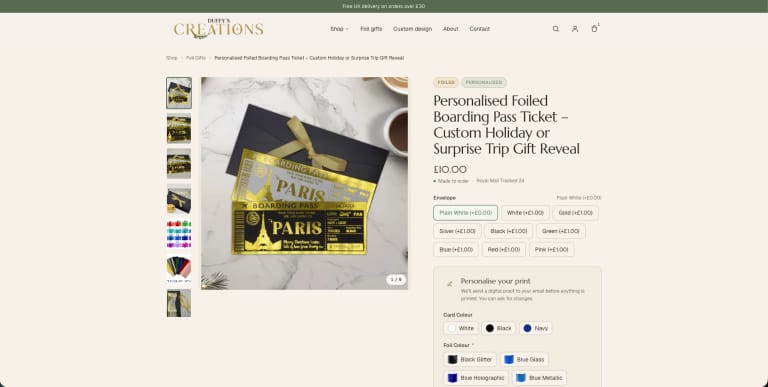
A real example: Duffy's Creations
Duffy's Creations is a personalised-print studio. They were on Shopify, which is a fine platform for plenty of shops, but they'd hit a specific wall.
They sell products with options. Sizes. Frame colours. The sort of choices that are the entire point of a personalised product. They were using an extra app to handle those options, and that app fought with the way the platform handled product variants underneath. The result was that customers would pick a size or a frame colour and the site would tell them it was unavailable when it wasn't. Sales were quietly walking out the door, and the cause was buried two layers deep in software nobody could fully see into.
We re-platformed them to a headless store. More than 200 products moved across with nothing lost. The thing that had been broken simply stopped being broken, because the options weren't a bolt-on fighting the system anymore. They were part of how the store was built.
The site scored 100 on Google's PageSpeed test. That's the top mark. I mention it not to show off a number but because that number is what a customer feels as "this just works."

What the last couple of years taught me
I don't build the way I used to. I'll be honest about that, because a lot of people in my trade aren't. The mechanical part of building software has changed enormously, and the part that matters now is judgement. Knowing what to build. Knowing what not to build. Knowing when something looks fine and isn't.
For a shop owner, none of that is your problem to solve, and it shouldn't be. But it does change what you should expect. You should expect a site that's built around your actual business, not bent to fit a platform's idea of what a shop is. You should expect to be able to change it whenever your business changes, without fighting the software to do it. You should expect it to be quick, and to stay quick.
The era where you had to bend your business around a sprawling platform, and pay a cut on every sale for the privilege, is ending. Websites are back, and that's a return to common sense, not a step backwards.
If your platform is getting in your way
If any of this sounds like your situation, a store that's slow, a stack of apps you're paying for and don't trust, options or variants that misbehave, a monthly bill that keeps climbing while the site keeps getting heavier, then it's worth a look at how a headless store would work for you.
That's what HD Commerce is for: a bespoke store built around how you actually sell, kept fast, with no fees skimmed off your orders. It's a small monthly cost rather than a big upfront build, so you get proper bespoke web development without the agency price tag. It's a subscription like the big platforms, but you're not boxed in by their templates and warring apps. When you need something changed, a developer changes it. If you're already on Shopify, Magento or similar, moving across is a well-worn path. Duffy's did it without losing a single product. Yours can too.
No pressure and no jargon. Just a faster shop, built around you, that changes when you need it to.