Most online shops are rented. You might not think of it that way, but that's what it is. You pay every month for the right to keep your store switched on. The platform owns the building. You own the stock inside it, and not always all of that.
For a lot of businesses that's a fair deal, and I'll come back to it. But there's a point where renting stops making sense. Usually it arrives the day the platform changes the rules on you. The monthly price goes up. A feature you relied on moves behind a higher tier. An app you've built your checkout around gets bought and shut down. Or the whole platform pivots, and the thing you built your business on quietly stops being the thing you signed up for.
If you've been on the receiving end of any of that, you already know the feeling. You're running a real business on top of someone else's decisions, and you don't get a vote.
This is about the other option. Owning the whole thing outright.
Why this matters more now than it used to
For a long time, owning your ecommerce platform meant a huge build, a team of developers, and a server room's worth of maintenance. It was the kind of thing only a large company could justify, and even they grumbled about it. So most people rented, because renting was genuinely the sensible call.
That's changed. The tools that serious stores are built on now are open, well documented, and run on infrastructure you can hold in your own accounts. A fast bespoke store is no longer a year-long project with a standing army behind it. Which means owning your platform is back on the table for businesses it was never realistic for before.
At the same time, the cost of renting has crept up. Not just the headline subscription. The cut taken on every sale. The apps stacked on top to fill gaps. The price rises that land in your inbox with thirty days notice. You can be paying a great deal every month and still not own a single part of what you've built.
What owning your stack actually means
There are three pieces to an online store, and ownership means you hold all three.
The first is the database. That's your products, your customers, your orders, your history. Everything the business actually runs on. In an owned setup this lives in your own Supabase account, in your name, on your billing. Not a slice of someone else's system that you can export from if they let you. Yours.
The second is the front end. That's the website itself, the pages your customers see and buy from. Built on Nuxt, which is a modern, fast, open foundation. The code sits in your repository. You can hand it to any competent developer and they can pick it up, because it isn't a proprietary dialect that only one company understands.
The third is the CMS, the part you log into to run the shop day to day. Add products, take orders, manage content, all of it. In an owned setup you get your own instance of the HD Commerce CMS, running for you, not a shared account on a platform that can change underneath you.
Hold all three and you don't have a subscription. You have an asset. The difference matters more than it sounds, and it shows up at exactly the moments you can't predict.
What it protects you from
Nobody can put your rent up, because there's no rent. The infrastructure costs what it costs to run, paid to the companies that actually run it, at their published rates. There's no platform sitting in the middle taking a margin and adjusting it whenever it likes.
Nobody can change the rules on you. The feature you depend on can't be moved to a pricier tier or quietly removed, because it's part of a system you own rather than a plan you're subscribed to.
Nobody can take a cut of your sales. When you sell something, the money is between you, your customer, and your payment provider. Stripe handles the card. No platform skims the middle.
Nobody can shut it down and take your store with it. Platforms get acquired. Platforms pivot. Platforms decide your kind of business isn't their focus anymore. When you own the database, the front end, and the CMS, none of that is an emergency. The thing keeps running because it answers to you.
And here's the part people underrate until they need it. You're not locked to me either. That's deliberate. I'll build it and set it up, but once it's yours it really is yours. The code is standard, the database is standard, the whole thing is documented. If you want to take it to another developer in two years, you can, with no permission needed and nothing held hostage. A platform you can only leave by abandoning everything you built isn't ownership. It's a nicer cage.
The approach is proven
I'm not selling a theory. I spent about fifteen years building online shops on Magento, ending up as a Head of Development running teams that built stores handling thousands of orders a day. I know what serious ecommerce demands, and I know exactly where the big platforms cost you. Moving to headless wasn't a fashion decision. It was where the work led once the tools got good enough.
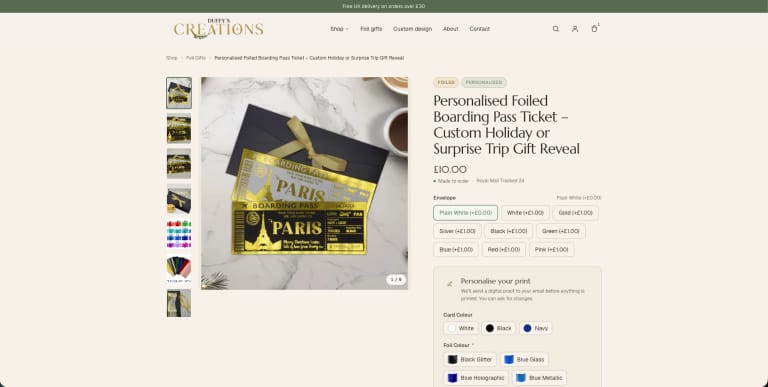
A straightforward example of the build working in practice is Duffy's Creations, a personalised-print studio. They'd been on Shopify and hit a wall, where an add-on app for product options fought with the platform's own variants and started telling customers that sizes and frame colours were unavailable when they weren't. Sales were walking out the door over a fault buried two layers deep in software nobody could fully see into. We re-platformed them to a headless store. More than 200 products moved across with nothing lost, the broken behaviour was simply gone, and the site scored 100 on Google's PageSpeed test, which is the top mark. That number is what a customer feels as "this just works."
The same foundation underneath that store is what an owned build is made of. The difference is purely who holds the keys.
Who this is for, and who it isn't
I'll be honest about the fit, because the wrong choice here is expensive in both directions.
Owning your stack is for businesses that are established enough to think in years rather than months. You've felt the downside of renting, or you can see it coming. You want a store that's a long-term asset on your own books, with no third party able to change the terms, take a cut, or disappear. You'd rather pay once to own it than forever to borrow it. If a vendor going away, or hiking their price, or shutting a feature would genuinely hurt your business, removing that risk is worth real money to you.
It is not for everyone, and I won't pretend otherwise. If you're earlier on, or you'd simply rather someone else carried the platform side entirely, owning the whole thing is more than you need. For a lot of smaller shops the managed route is the better call, and that's a real product, not a consolation prize. HD Commerce is a bespoke headless store on a monthly subscription, built around how you actually sell, kept fast, with no fees skimmed off your orders. You don't own it, but you also don't carry it, and for plenty of businesses that's exactly the right trade. If that sounds more like you, start there.
The owned tier is the other end of the same idea. Same engineering, same speed, same lack of a platform tax. The difference is that at the end of it, you hold the whole thing.
If you want to own it
An owned build is a one-off piece of work. I build it, set up your database, your front end, and your own instance of the CMS, hand it over, and from that point it belongs to you. Because every owned store is shaped around a real business rather than a template, the right place to start is a conversation about yours.
If you've been burned by a platform before, or you can see the lock-in coming and you'd rather own the thing than keep renting it, get in touch and we'll talk through what owning your store would actually look like for you.
No price on this page on purpose. What it costs depends on what you're building, and that's a real answer rather than a dodge. Websites are back, and owning one outright is more within reach than it has been in years.
Owning your store, answered
Common questions about owning a headless store outright rather than renting it from a platform.
It means you hold all three pieces of the shop. The database of products, customers and orders sits in your own Supabase account. The front end is your code in your repository. The CMS you log into is your own instance. Hold all three and you have an asset, not a subscription you keep paying to keep switched on.
No, and that is deliberate. I build it and set it up, but once it is yours it really is yours. The code is standard, the database is standard, the whole thing is documented. If you want to take it to another developer in two years you can, with nothing held hostage and no permission needed.
There is no rent, so nobody can put your price up and no platform takes a cut of your sales. The infrastructure costs what it costs to run, paid to the companies that run it at their published rates. An owned build is a one-off piece of work rather than a fee forever, though whether it pays off depends on your size and stage.
No, and I will say so. If you are earlier on, or you would rather someone else carried the platform side, owning the whole thing is more than you need. HD Commerce is a managed headless store on a monthly subscription, built around how you sell, with no fees skimmed off orders. For a lot of smaller shops that is the better call.
Not any more. The tools serious stores run on are now open, well documented and run on infrastructure you hold in your own accounts. A fast bespoke store is no longer a year-long project with a standing team behind it. I rebuilt Duffy's Creations off Shopify, moved over 200 products, and the site scored 100 on Google's PageSpeed test.